
On this page
Engineering summary. A copper heat spreader does one job: pull heat sideways out of a small hot spot so it enters the cooling stack over a wider area. It is not a heatsink and it does not by itself lower junction temperature — the interface, flatness, plating and the base beneath it decide that. This page covers when copper is the right spreader material, why copper-tungsten exists, and what to put on the drawing.
For the coating interface, review our electroplating capability. For another material option, see the diamond heat-spreader guide.
What a heat spreader actually does — and what it does not
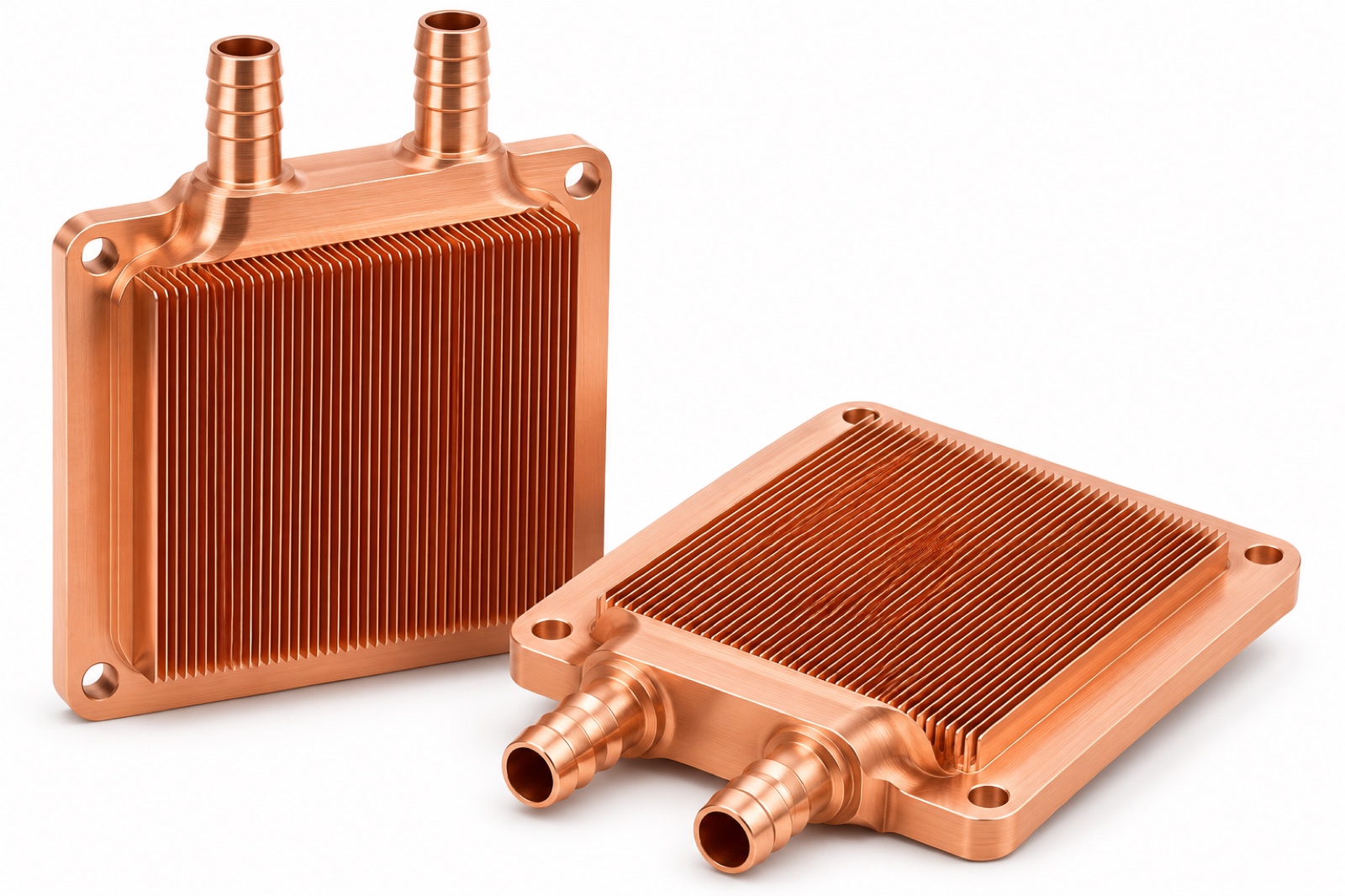
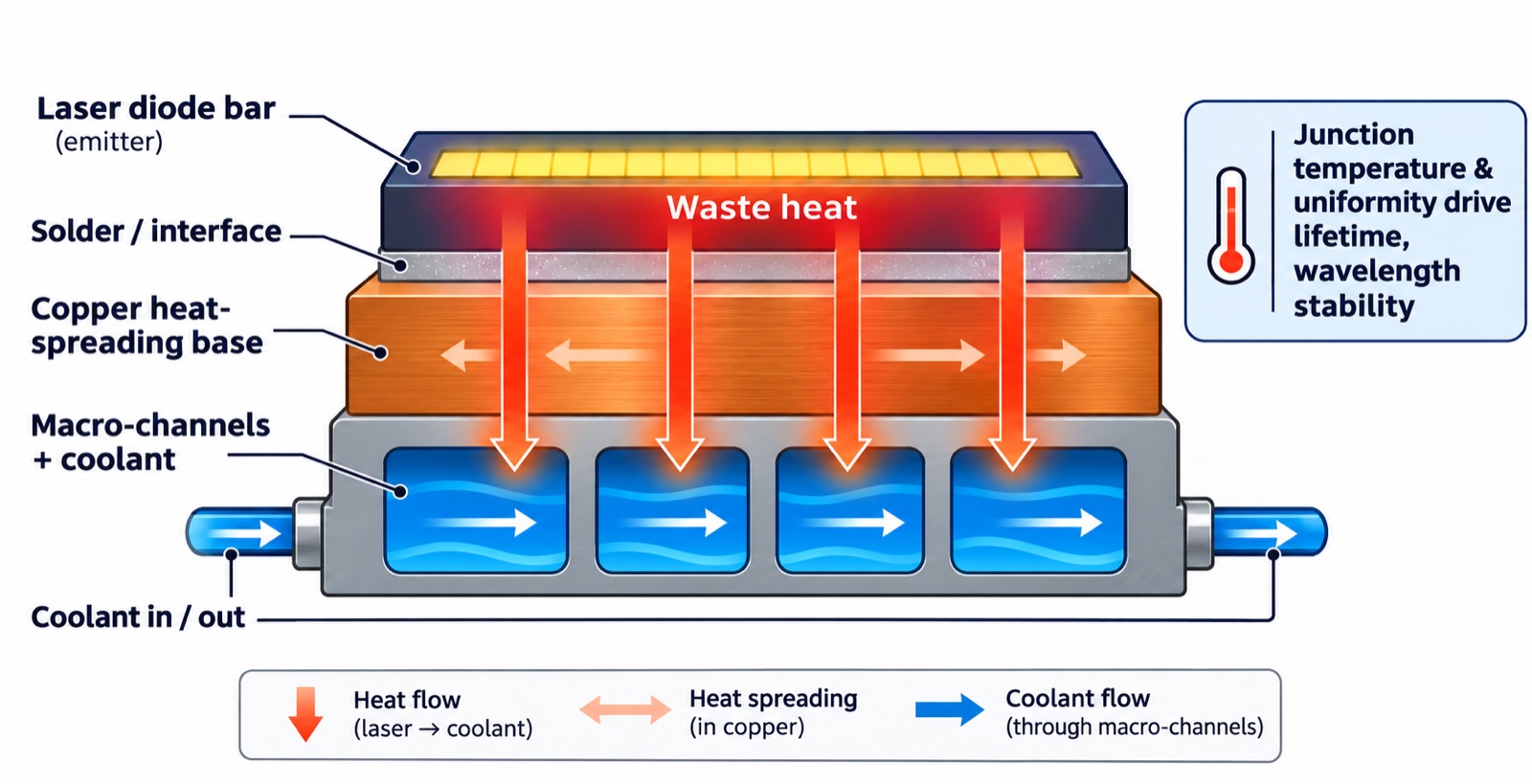
A heat spreader is the plate that sits directly against the die or laser bar. Heat leaves a die through a footprint of a few square millimetres. If that small footprint meets the cooling stack directly, the thermal resistance is high because the heat has nowhere to go sideways. The spreader’s job is to move that heat laterally into a much larger area before it crosses into the base or cold plate. Larger area means lower heat-flux density at the next interface, which is where most of the temperature drop actually happens.
Two things this does not do: it does not replace a heatsink or cold plate, and it does not guarantee a junction temperature. A spreader with poor flatness or a bad interface can be worse than no spreader — it adds two interfaces and a layer of material without solving the lateral spreading. The number that matters is not the spreader’s bulk conductivity alone; it is conductivity in the plane combined with the contact quality above and below.
Copper, copper-tungsten and copper-molybdenum: pick by the constraint you cannot move
Oxygen-free copper is a common heat-spreader candidate. Compare conductivity, mass and thermal expansion together. Its expansion mismatch with silicon, GaAs or ceramics depends on the material and temperature range; use the relevant data and assess the bonded area and joint stress.
Copper-tungsten and copper-molybdenum composites offer ways to balance conductivity and expansion. Composition, microstructure and manufacturing route affect the result. Specify the copper/refractory-metal ratio, grade and its material data rather than assigning one property range to all CuW or CuMo materials.
The table uses Plansee’s published tungsten-copper reference data. In these designations, the number after WCu is the nominal copper content by weight; do not interchange naming conventions or supplier grades.
| Plansee material | Nominal Cu (wt.%) | Conductivity at 20°C (W/m·K) | Mean CTE, RT–400°C (10⁻⁶/K) |
|---|---|---|---|
| WCu10 | 10 | 194–210 | 6.6–7.0 |
| WCu15 | 15 | 218–220 | 8.0–8.2 |
| WCu20 | 20 | 236–238 | 9.2–9.5 |
Source: Plansee Thermal Management, 25 July 2024, Properties table. These are that manufacturer’s reference values, not JYX supply specifications. Confirm the actual grade, composition, temperature range and acceptance documents for the project.
Flatness is the spec that decides whether the spreader works
Every article about thermals says “good flatness.” That word hides the real requirement. What matters is contact area at the operating condition, and there are two different flatness numbers a machine shop can report:
- Free-state flatness — measured before the part is bolted down.
- Mounted (assembled) flatness — measured after the screws or clamps are torqued to the value you will actually use.
A thin spreader will bend to the surface it is clamped to. That can help (it conforms) or hurt (it bows away from the die in the middle). If the drawing only says “flatness 0.01 mm” without stating free-state or mounted, the shop will measure the easier one and the part can still fail in the stack. Specify the state, the clamping, and the measurement method — otherwise the number is a label, not a control.
Plating is part of the thermal path, not decoration
Copper oxidises, and oxide is a thermal and solder barrier. Spreaders are usually plated before die attach or soldering: nickel as a diffusion barrier, gold as a solderable and oxidation-resistant outer layer, sometimes a full Ni/Au stack. Two practical points that decide yield:
- The plating stack and thickness belong on the drawing. A “gold-coloured” part is not evidence of a gold specification; a thin, porous or poorly adherent layer fails at reflow or after thermal cycling.
- Coverage and masking matter where the part is bonded or soldered. Plating that creeps onto a bond face, or a masked area that should have been plated, is a rework or a scrap. State which zones are plated and which are not.
Where a copper spreader is usually seen
Typical uses from the parts we see: laser diode submounts and bars where a copper heat-spreading base sits between the emitter and a macro-channel or microchannel cooler; high-power RF and power devices that need a low-expansion carrier; and instrument or detector packages that need a thermally conductive, plateable base. In every case the spreader is one layer of a stack, and the stack is what gets validated.
What we make, and what we do not
We machine copper, oxygen-free copper, copper alloys and copper-aluminium assemblies, and we machine and plate to drawing. Copper-tungsten and copper-molybdenum may be evaluated on request, subject to material availability and a drawing review — they are not a stock item and we will say so rather than promise a grade we cannot source.
We do not publish a thermal resistance or junction temperature for a spreader, because that number depends on the die, the interface material, the clamping and the cooler — none of which we control alone. We do not claim a hermeticity or leak rate except as agreed and tested per drawing.
What to send with the RFQ
Send the drawing revision, 2D drawing and STEP model, the material grade you intend (or the CTE and conductivity window you need, and we will propose a grade), the flatness requirement and its measured state (free or mounted) with the clamping force, which zones are plated and to what thickness, the bond or solder process and its peak temperature, and the acceptance criteria. With those we can quote a manufacturable part and tell you where the design is at risk before any metal is cut.
Send the thermal-stack drawing, material and interface requirements for review
Frequently asked questions
Is copper always better than aluminium for a spreader? For lateral spreading, copper’s higher conductivity usually wins, but copper is heavier and expands more. Aluminium is chosen when weight and cost dominate and the heat flux is not concentrated. The choice follows the constraint you cannot move, not a default.
Why not just use diamond? Diamond spreads heat better than copper, but it is far more expensive and harder to join. Copper and CuW cover most of the volume; diamond is reserved for the cases where nothing else closes the thermal budget. See our diamond heat spreader guide for that end of the range.
Do you supply the die attach or solder too? We machine and plate the spreader. Die attach, solder preforms and full module assembly are separate and only included when agreed in the project scope. State the process and peak temperature so the plating is specified for it.