
On this page
Engineering summary. Single-crystal diamond may be evaluated as a heat spreader for selected electronics. Crystal quality, the thermal interface, joining and the full assembly govern results; supplied sample dimensions are not general product guarantees.
| Decision | Why it matters | What to confirm |
|---|---|---|
| Diamond grade | Material properties and quality vary | Supplier specification, orientation and condition |
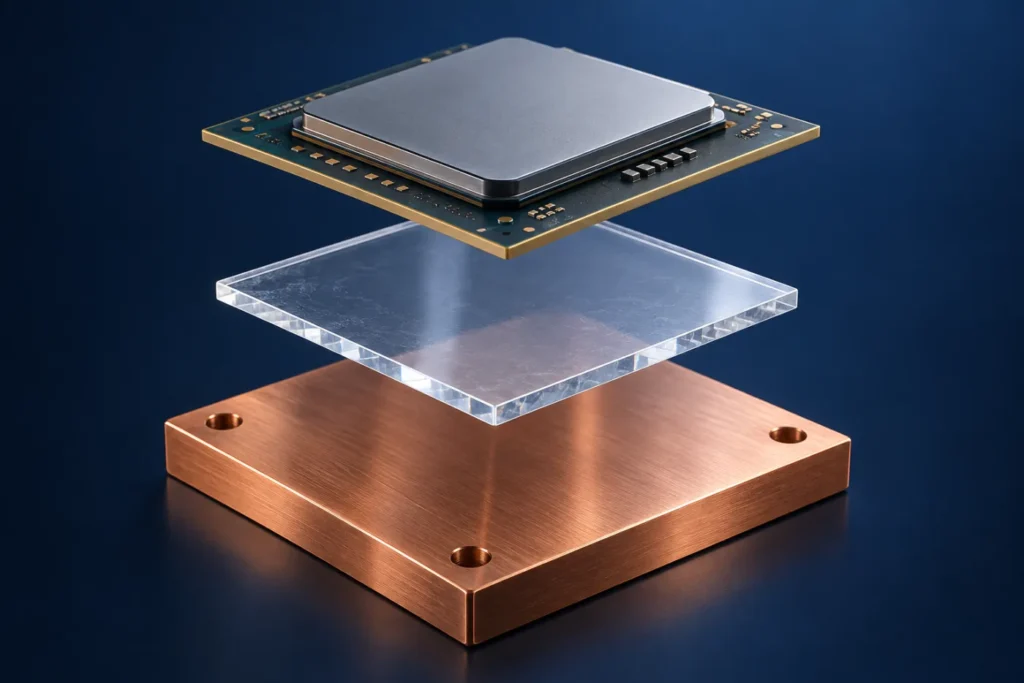
| Interface | Bond layers and contact can add thermal resistance | Joining method, acceptance limits and test conditions |
| Assembly | The heat spreader is part of a longer heat path | Mating materials, dimensions and validation |
Introduction
As power density increases in semiconductor devices and optoelectronic systems, removing heat from a compact package becomes an increasingly important design challenge. Single-crystal diamond is of interest for selected thermal-management applications because of its high thermal conductivity and potential suitability for demanding electronic and optical environments. Depending on the device architecture, a diamond component may serve as a heat spreader, a thermal-management insert, or part of a package or optical assembly.
Why Consider Single-Crystal Diamond?
Diamond can spread heat away from localized hot spots, helping reduce temperature gradients when properly integrated into a package. Its usefulness depends not only on the intrinsic properties of the diamond, but also on component geometry, crystal quality, surface condition, mounting method, interface resistance and the heat path into the surrounding structure. Diamond is not a universal replacement for copper, molybdenum-copper or other established materials; it is an option to evaluate when thermal, electrical, dimensional and cost requirements justify it.
Reading the Supplied Material Specification
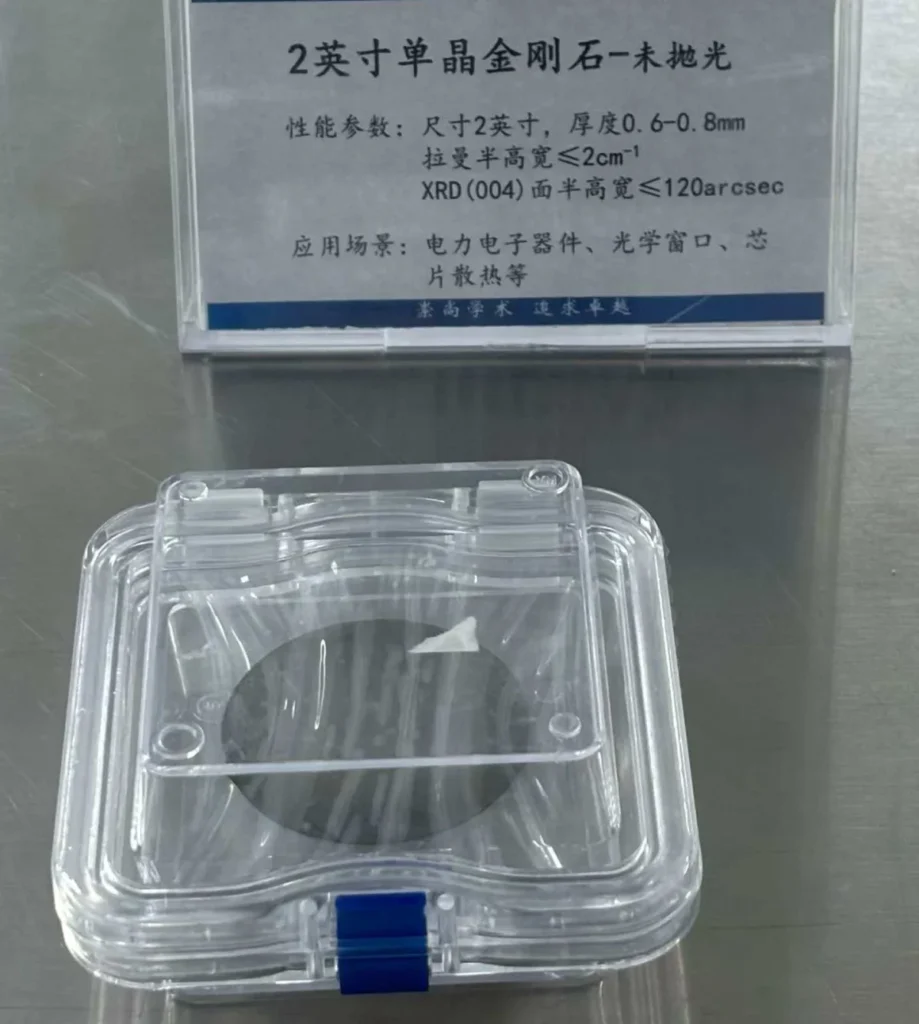
A user-supplied photograph of a reference sample identifies a 2-inch single-crystal diamond plate in an unpolished condition, with a thickness of 0.6–0.8 mm. The photographed card also lists a Raman peak full width at half maximum (FWHM) of no more than 2 cm⁻¹ and an X-ray diffraction (004) rocking-curve FWHM of no more than 120 arcsec. Raman spectroscopy can help assess crystal quality and stress-related features, while X-ray diffraction evaluates crystallographic quality and orientation-related characteristics. These indicators do not, by themselves, establish the thermal performance of a finished assembly.
Manufacturing and Integration Considerations
For a custom diamond heat spreader, the manufacturing plan should begin with the approved drawing and intended device interface. Key items include the required outline and thickness, allowable edge damage, surface finish, flatness, parallelism, orientation, and any holes, notches or other features. Diamond is extremely hard, so machining and finishing routes differ from conventional metal CNC machining. Where the design requires bonding or metallization, the interface stack and joining method must be selected for the substrate, operating temperature, thermal cycling and reliability requirements.
Inspection and Verification
A project-specific inspection plan may include dimensional measurement, thickness mapping, surface and edge inspection, flatness or parallelism measurement, Raman spectroscopy, and X-ray diffraction where specified. For a completed thermal assembly, verification may also need to assess interface quality, thermal resistance, temperature distribution or device-level performance under representative operating conditions. Acceptance criteria should be defined in advance and tied to the approved drawing and customer specification.
How Jingyixin Can Support Custom Diamond Thermal Components
JYX reviews custom precision-component enquiries from drawings, models, samples and application requirements. For diamond-related projects, material availability, processing, external coordination, inspection responsibilities and feasibility are subject to project-specific review; no in-house diamond processing or inspection capability is implied.
Conclusion
Single-crystal diamond can be a valuable option for thermal spreading in selected high-power electronic, semiconductor and optoelectronic applications. Successful implementation depends on more than material selection: interface design, geometry, surface quality, joining strategy and verification all influence the final result. A clear drawing and defined application and acceptance requirements are the best starting point for evaluating a custom diamond heat-spreader project.
Discuss Your Project with Jingyixin
Planning a custom diamond heat spreader? Share your drawing, required material specifications, interface details and application conditions with Jingyixin for a project-specific manufacturing feasibility review.
Technical Note
This article is intended for general engineering reference. The specifications shown are transcribed from the supplied product information and should be verified against the current supplier datasheet and approved project documentation. Actual material availability, processing route, tolerances, inspection methods and performance must be confirmed for each project.
Frequently asked engineering questions
Is diamond always better than copper for a heat spreader?
Not necessarily. The full heat path, interface resistance, reliability, geometry, availability and cost need to be evaluated for the application.
Do Raman or XRD results prove a completed assembly meets its thermal target?
No. They can describe aspects of the material, but assembly-level thermal performance depends on the interfaces and must be tested under specified conditions.
Are the sample values a guaranteed product specification?
No. The photographed card describes one supplied reference sample. Current availability, material data, processing and acceptance requirements must be confirmed for each project.
Technical references
IEEE Electronics Packaging Society, diamond thermal interface review; Chen et al., copper/diamond thermal composites and interfaces, Journal of Materials Science. These sources discuss material and interface research, not JYX product certification.
Related engineering resources
- Laser package thermal path
- Liquid-cooled cold plate design
- Aluminum liquid cold plate
- Copper heat sink
- Precision CNC machining
- Precision Heat Sinks for Semiconductor Laser Packaging: Fin Geometry, CNC Quality and Thermal Validation
- Diamond Thermal Components: Manufacturing Requirements and Inspection
Discuss drawings and requirements with JYX engineering; project scope and capabilities are confirmed before quotation.