
On this page
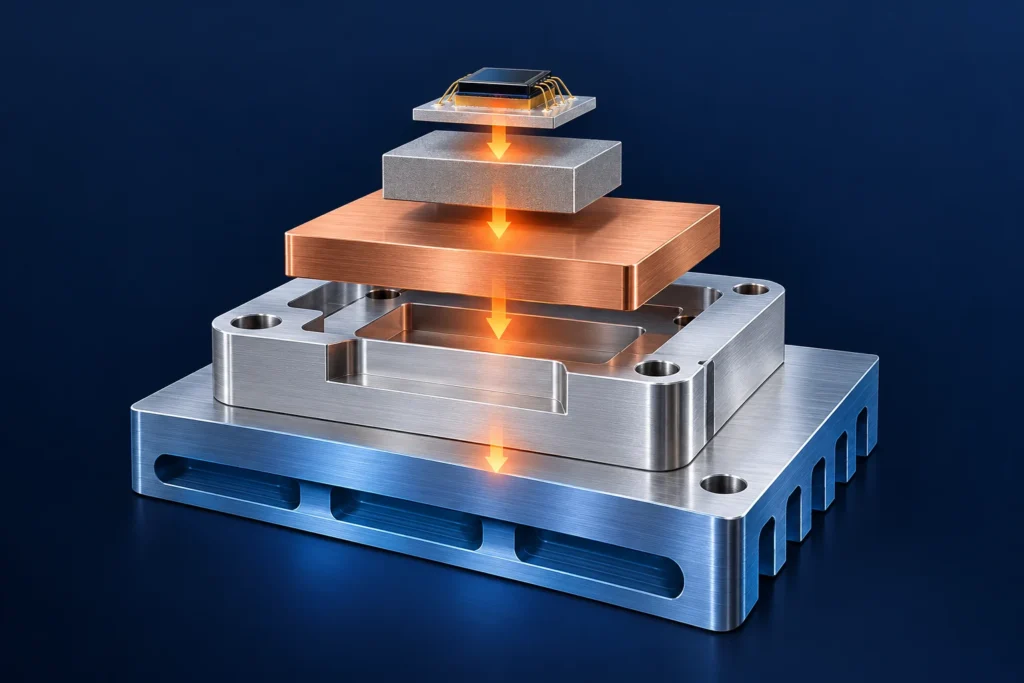
Engineering summary. A semiconductor laser package needs a continuous, low-resistance thermal path. Select materials for conductivity and expansion compatibility, control the mating surfaces and joining layers, and verify the complete assembly under defined cooling conditions.
| Material | Typical design role | Review before selection |
|---|---|---|
| Copper | Heat spreading and thermal conduction | Mass, joining method and interface geometry |
| Aluminium | Lightweight heat sinks and cooling components | Coolant or environmental compatibility and surface treatment |
| MoCu / CuW | Heat spreaders with expansion-control requirements | Grade-specific properties, machining and joining compatibility |
| Kovar | Package structures interfacing with glass or ceramics | Expansion matching and its role within the complete thermal path |
Introduction
High-power semiconductor lasers convert only part of their electrical input into useful optical output; the remaining energy becomes heat that must be conducted away from the active region. As power density increases and packaging becomes more compact, thermal management is no longer just a question of adding a larger heat sink. It depends on the complete thermal path: the laser bar or chip, the bonding layer, the submount or heat spreader, the package base, and the final air- or liquid-cooling interface. In their 2021 review, Yan, Zheng, Sun and Duan identify thermal management as a key challenge in high-power semiconductor laser packaging, noting that elevated temperature can affect output power, wavelength, electro-optical efficiency, service life and optical alignment.
1. Start with the complete thermal path
A useful engineering approach is to treat the package as a series of thermal resistances. Heat must pass through every interface between the active laser and the cooling environment. A high-conductivity material cannot compensate for a poorly bonded interface, excessive flatness error, an uneven solder layer or inadequate contact pressure. Thermal design should therefore consider the whole assembly rather than selecting a material in isolation.
For production engineering, this means identifying the heat source, heat-flow direction, mounting surfaces, joining layers and cooling boundary conditions before finalizing the component drawing. The key geometric features may include the chip mounting plane, submount thickness, heat-spreader footprint, cooling-channel position and the interfaces that must remain flat after joining.
2. Select materials for both conductivity and compatibility
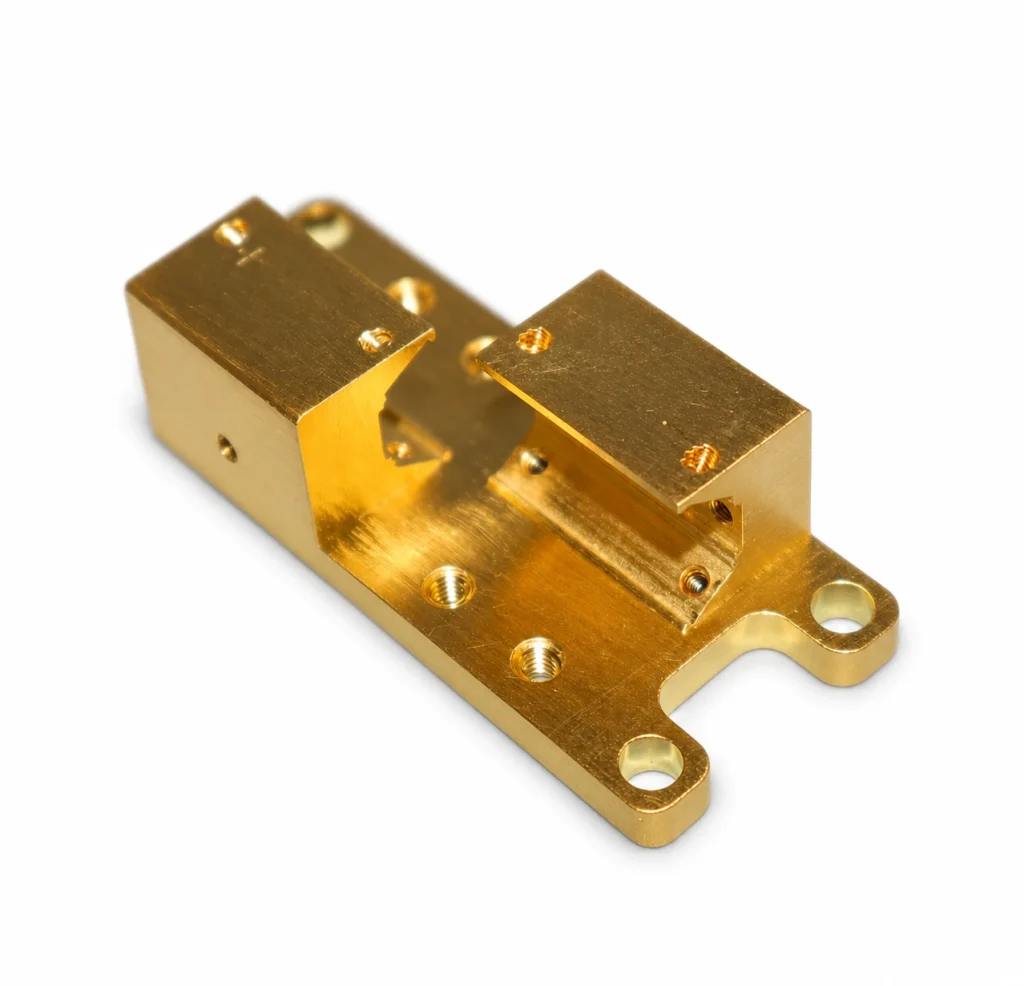
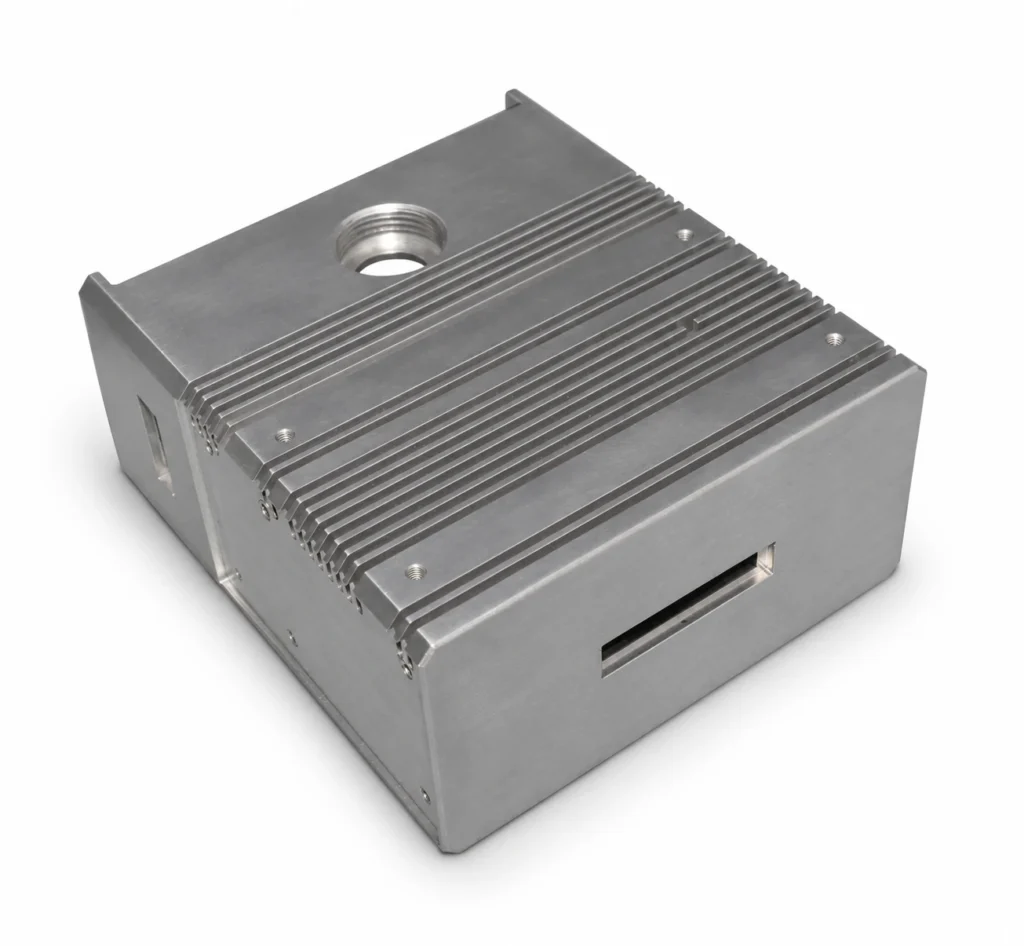
Copper and aluminium are widely used where high thermal conductivity and manufacturability are important. Copper-based heat spreaders can provide an efficient heat path, while aluminium is useful for larger, lightweight finned heat sinks. For demanding packages, material selection may also need to consider coefficient of thermal expansion, stiffness, corrosion compatibility, joining method and the location of the heat source.
Molybdenum-copper (MoCu) and tungsten-copper (CuW) are worth evaluating where a combination of thermal management and controlled thermal expansion is required. Kovar is commonly considered for package structures where expansion compatibility with glass or ceramic components is important. These materials are not interchangeable: the right choice depends on the device architecture, temperature range, joining process, electrical requirements and cost target.
JYX reviews custom precision-component projects involving MoCu, CuW, Kovar, special steels and aluminium against the required material and drawing specifications. Final material selection and performance targets should be agreed against the customer’s drawing, device requirements and material specifications; no single material is optimal for every laser package.
3. Precision machining defines the contact interface
A thermal interface is only as effective as its geometry and surface condition. Flatness, parallelism, surface roughness, local steps and burrs can all affect real contact area and the uniformity of the joining layer. For a laser submount or heat spreader, a mounting surface that looks visually acceptable may still need dimensional verification before assembly.
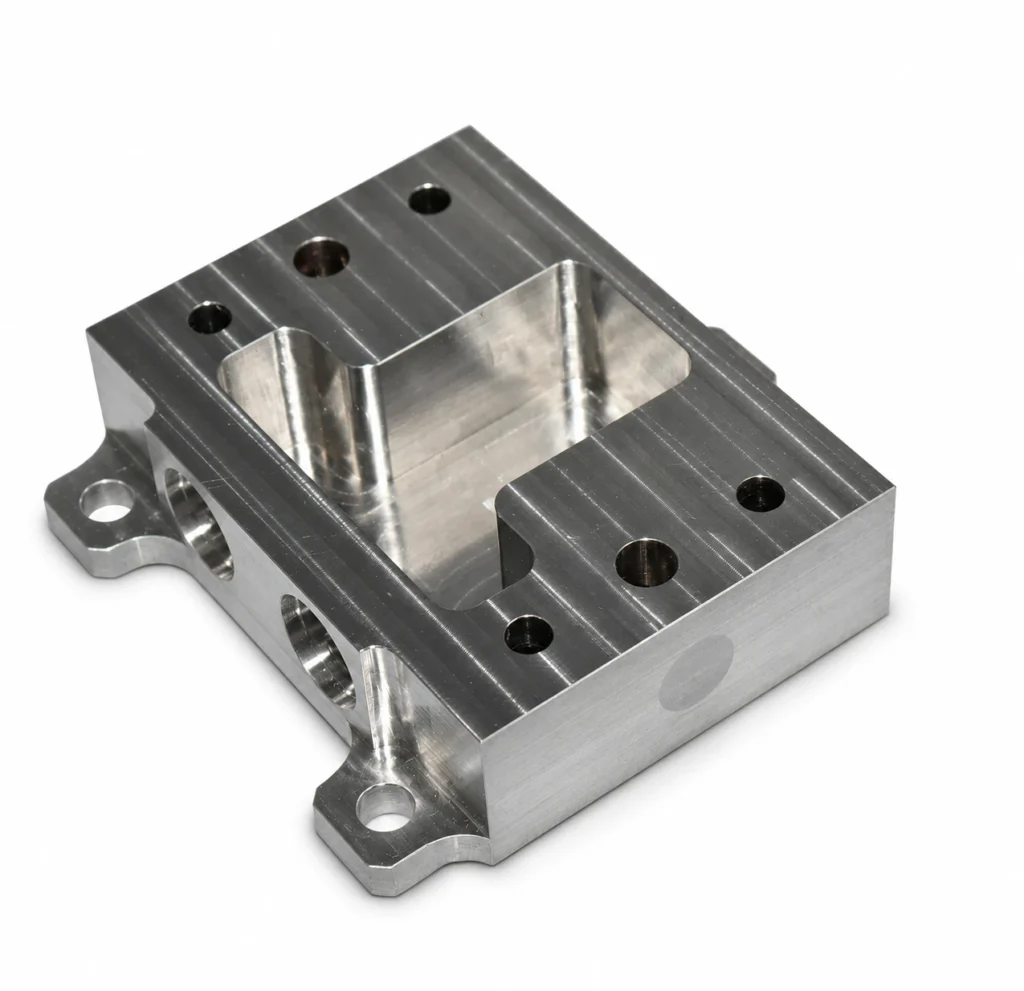
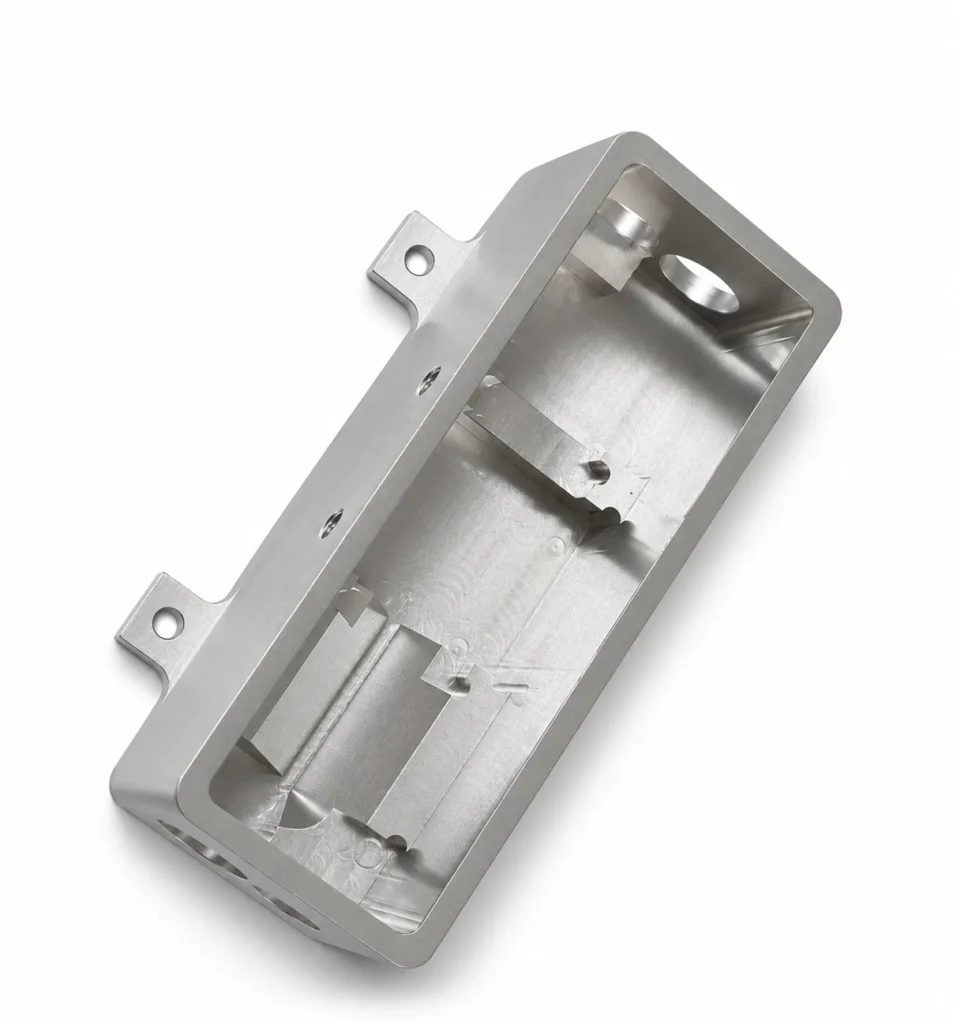
Depending on the part design, manufacturing may include precision CNC milling, drilling, pocketing, datum-face finishing, deburring and controlled cleaning. Thin walls and deep cavities require attention to tool access, workholding, cutting forces and residual deformation. For components with multiple mounting levels, the machining sequence should preserve the relationship between the laser mounting plane, package datums and cooling interface.
The practical objective is not simply to achieve a tight tolerance on every dimension. It is to identify the critical-to-function dimensions and control them consistently across prototypes and production batches.
4. Joining layers and interface quality
The joining layer between the laser device, submount and heat spreader can contribute a meaningful share of the total thermal resistance. Bond-line thickness, voids, wetting, material compatibility and process repeatability therefore deserve explicit attention. Depending on the package architecture, joining may involve soldering, brazing, sintering or another qualified bonding method.
Where vacuum brazing or other thermal joining processes are used, the process plan should account for thermal distortion and the possibility that a component’s dimensions will change after joining. Critical mounting surfaces may need post-joining inspection or finishing, while the acceptance criteria should specify which dimensions are measured before and after the joining operation.
For an outsourced or integrated manufacturing chain, it is important to define responsibility for secondary operations, cleaning, joining, surface treatment and final inspection. Process ownership and traceability help prevent a dimensionally correct machined part from failing at assembly.
5. Inspection methods that connect design to performance
A practical inspection plan can combine:
- Dimensional inspection: CMM or suitable precision measurement for datum relationships, hole positions, step heights and critical dimensions.
- Surface inspection: flatness, parallelism and surface roughness checks on heat-transfer and mounting faces.
- Visual and cleanliness inspection: burrs, machining damage, residues and contamination.
- Joining inspection: visual examination and, where appropriate, metallographic sampling, X-ray or other methods selected for the joint design.
- Thermal verification: thermal resistance or temperature-rise testing at a defined heat load and cooling condition, when required by the customer.
- Reliability verification: thermal cycling or other qualification tests where the application requires them.
The specific methods and acceptance limits should be selected from the product drawing, customer specification and qualification plan. A generic inspection list is not a substitute for a validated test method.
6. Manufacturing takeaway
The central lesson is that laser-package thermal performance is a system result. Material conductivity, expansion compatibility, machining accuracy, interface quality and joining repeatability must work together. Precision component suppliers can add value by helping customers review manufacturability early, identify critical thermal interfaces, select realistic tolerances and define measurable inspection criteria.
Jingyixin’s relevant manufacturing scope includes custom precision CNC components, thermal-management parts and work with MoCu, CuW, Kovar and aluminium. Depending on the drawing and project requirements, this can support prototype development and production of heat spreaders, mounting bases, laser-package housings and related precision components. Thermal performance itself should be confirmed through the customer’s assembly-level testing rather than inferred from material choice or machining accuracy alone.
Conclusion
A robust high-power laser package starts with a well-defined thermal path. The most reliable outcome comes from matching material properties with precision geometry, controlled joining and verification at the interface level. By addressing these factors together, engineering teams can reduce avoidable thermal bottlenecks and improve the manufacturability of laser-package components.
Reference
Yan, Y., Zheng, Y., Sun, H., & Duan, J. (2021). Review of Issues and Solutions in High-Power Semiconductor Laser Packaging Technology. Frontiers in Physics, 9, 669591.
Technical Note
This article draws on published research and general engineering principles to discuss manufacturing considerations for thermal management components. It is intended for technical reference and does not represent product-specific performance claims or certification by Jingyixin. Actual manufacturing capabilities, materials, tolerances, joining processes and inspection requirements are confirmed project by project against approved drawings and customer specifications.
Engineering questions
Which materials should be evaluated for semiconductor laser packaging?
Copper and aluminium are common thermal-management options. MoCu and CuW may be evaluated when heat spreading and controlled thermal expansion both matter. Kovar may suit package structures requiring expansion compatibility with glass or ceramics. Select the material against the complete assembly requirements.
Can a high-conductivity material solve a poor thermal interface?
No. Flatness errors, burrs, uneven bond layers and voids can restrict heat transfer even when the bulk material conducts heat well. Material choice and interface quality need to be considered together.
What information is needed for a thermal-component RFQ?
Provide 2D drawings, a 3D model where available, material grade, mounting datums, critical flatness and roughness requirements, joining sequence, quantity and agreed inspection criteria. Include the heat load and cooling conditions when thermal verification is required.
Related engineering resources
- Laser package housings
- Aluminium liquid cold plates
- Precision CNC machining
- Aluminium vs copper cold plates
- Liquid-cooled cold plates for laser systems
Discuss a component drawing
Share your drawing, material, quantity and acceptance criteria with Shenzhen Jingyixin Machinery Technology Co., Ltd. (JYX) for a project-specific manufacturability review.