
On this page
Engineering summary. A diamond plate becomes a usable thermal component only when geometry, edge condition, surface finish, interface and inspection are defined. Availability and processing responsibilities must be reviewed for each project.

| Stage | Examples of requirements | Project-specific evidence |
|---|---|---|
| Incoming material | Grade, size, condition and documentation | Supplier records and agreed sample checks |
| Finished part | Outline, surface, edges and thickness | Defined inspection locations and acceptance criteria |
| Assembly | Bonding, mating materials and operating environment | Interface quality and test conditions |
Introduction
A diamond plate is only the starting point for a successful thermal-management component. In power electronics and semiconductor packaging, the finished part must meet dimensional, surface, interface and reliability requirements specific to the device. A 2-inch single-crystal diamond plate may be considered for applications such as heat spreading near a high-power chip, selected electronic components, or optical assemblies, provided its material and geometry are compatible with the design.
Potential Applications
The supplied product information identifies three application areas: power-electronic components, optical windows and chip heat dissipation. These applications can impose different requirements. A heat spreader is primarily concerned with conducting and distributing heat; an optical window may additionally require optical transmission, surface finish and cleanliness specifications; and a component integrated into a semiconductor package may require controlled thickness, flatness, edge quality and a reliable thermal interface. The exact application should be established before selecting a manufacturing route.
Material specifications and documentation
The supplied reference material describes an unpolished single-crystal diamond plate. Confirm the specific grade, dimensions, material condition, inspection method and supplier documentation for the blank or finished part. A sample card does not establish stock, finished-part capability or a guaranteed specification.
Design Inputs Before Manufacturing
Before production, the customer and manufacturer should agree on the finished diameter or outline, thickness tolerance, surface finish on each side, flatness, parallelism, crystal orientation if relevant, edge-chamfer or edge-protection requirements, and any additional features. The assembly design should also identify the mating material, contact pressure, thermal interface material or bonding layer, operating temperature range, and thermal-cycling conditions. These details help determine whether the proposed design is manufacturable and how it should be inspected.
Quality Control and Test Planning
A robust quality plan separates incoming-material verification from finished-part inspection and assembly-level validation. Incoming checks may include supplier documentation, dimensions, visual condition and, where required, Raman or XRD results. Finished-part checks may include thickness, outline dimensions, surface defects, edge chips, flatness and parallelism. If the component is used for heat dissipation, thermal resistance or device-level temperature testing may be required. If used as an optical window, optical transmission, surface quality and cleanliness criteria may also apply. Not every test is necessary for every project; the inspection plan should follow the drawing and customer specification.
Manufacturing Feasibility and Project Collaboration
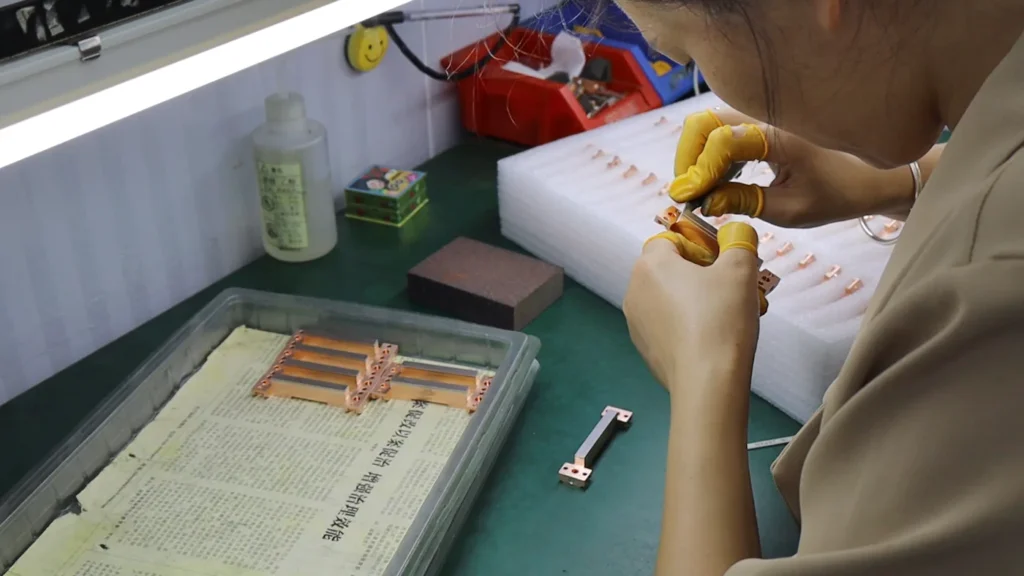
Diamond processing differs from machining common metals such as aluminum or copper. The extreme hardness of diamond and the sensitivity of thin plates to edge damage make the selected processing and handling route important. Any polishing, shaping, metallization, bonding or joining operation should be specified and validated for the intended application. JYX can review drawings, models and quantities to discuss project feasibility; actual diamond processing, sourcing, inspection and any external coordination must be confirmed per project. Specific process availability and performance requirements are confirmed project by project.
Conclusion
The value of a diamond heat sink or heat spreader comes from the complete component and its integration into the device—not from the material name alone. Clear requirements for geometry, surface condition, interfaces and verification make it easier to evaluate cost, lead time and technical feasibility. For a custom project, begin with the application, approved drawing and performance criteria that the finished assembly must meet.
Discuss Your Project with Jingyixin
Have a diamond heat-sink or heat-spreader project in development? Send Jingyixin your 2D drawing, 3D model, material requirements and expected quantity to start a manufacturing feasibility review.
Technical Note
This article provides general engineering and manufacturing information. Application suitability and all product specifications must be confirmed against the current material datasheet, approved drawing and customer requirements. No specific thermal performance, certification or finished-part capability is implied without project-specific verification.
Frequently asked engineering questions
What should be included on a custom diamond component drawing?
Identify the material grade, outline, thickness, each surface finish, flatness, edge requirements, orientation if relevant, interface and measurement locations.
Are incoming, finished-part and thermal tests the same?
No. They address different requirements. Define supplier documentation, finished dimensions and assembly-level testing separately as needed.
Can every diamond plate be processed with conventional metal CNC methods?
No. Diamond hardness and delicate thin edges require an application-specific processing and handling plan; available processes must be confirmed before quotation.
Technical references
IEEE Electronics Packaging Society, diamond thermal interface review; Chen et al., copper/diamond thermal composites and interfaces, Journal of Materials Science. These sources discuss material and interface research, not JYX product certification.
Related engineering resources
- Laser package thermal path
- Liquid-cooled cold plate design
- Aluminum liquid cold plate
- Copper heat sink
- Precision CNC machining
- Precision Heat Sinks for Semiconductor Laser Packaging: Fin Geometry, CNC Quality and Thermal Validation
- Single-Crystal Diamond Heat Spreaders: Materials, Interfaces and Design
Discuss drawings and requirements with JYX engineering; project scope and capabilities are confirmed before quotation.